Technical tips, case studies, and thoughts on the modern web.
Technology
Conversational assistants, Claude Code and Codex: what is the difference?
Chatting with AI or delegating work in a project: the tools, access and workflow make the difference.
3 min read
AIAgents
A conversational assistant: understand and prepare
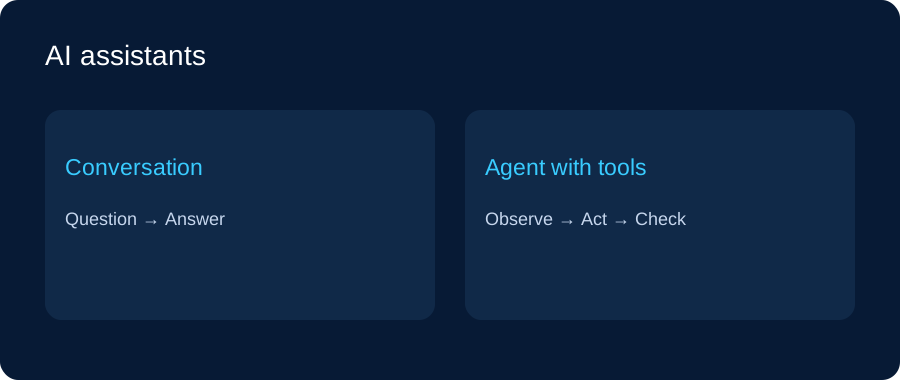
It helps explain concepts, compare options, draft text or suggest code. Without access to your project, you provide the context and apply its suggestions yourself.
An agent: work in an environment
An agent combines AI with tools and a working loop: observe, act, check the result and adjust. With the necessary access, it can change files directly.
Claude Code and Codex
Claude Code by Anthropic and Codex by OpenAI are agentic development tools. They can inspect a project, edit code and run commands or tests. Their capabilities depend on the environment, available tools and permissions.
Example: a broken form
In a conversation, you share the code and error, then apply the suggested fix. An agent working in the project can locate the relevant files, prepare a fix, run available checks and present the changes for review. If checks fail, it can continue investigating.
The boundary is not absolute
Conversational assistants can also have web search, files and execution tools. Agents can simply answer questions. The distinction is the access provided and work delegated, not the chat window.
Which should you choose?
A conversation is often enough to learn, think or prepare content. An agent can help implement project changes. Define the expected result and review the work: passing tests does not guarantee that there are no errors.
A framework provides structure and tools for building websites and applications. It avoids starting from scratch, but must suit the project.
2 min read
FrameworksWeb development
A foundation for building
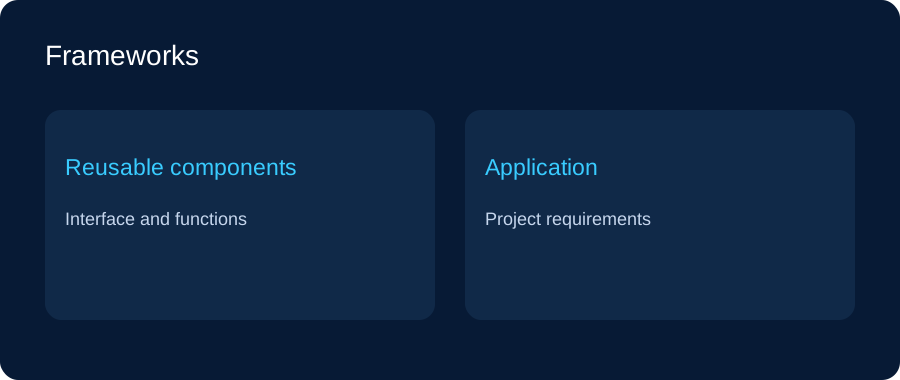
A framework supplies code organisation, conventions and reusable tools. Like the structure of a building, it guides construction without determining the finished result.
What does it do?
Depending on the framework, it can help manage pages, forms, user accounts or database access, leaving more time for project-specific features.
Browser or server
Some frameworks organise interactive interfaces in the browser. Others structure server-side data access, business rules and permissions. A project may use both.
Benefits and limitations
A shared structure helps teamwork and maintenance. It also requires learning conventions, installing updates and managing dependencies. A framework alone guarantees neither speed nor security.
Is it essential?
No. HTML, CSS and JavaScript may be enough for a simple website. More complex applications may benefit from a framework. The choice depends on requirements, team skills and future maintenance.
SEO
Local SEO for craftspeople and merchants in Alsace
Ranking well on Google when someone searches for your trade in your town isn't complicated. But you need to know the basics.
6 min read
SEOLocal
When a potential customer types "plumber Thann" or "restaurant Husseren-Wesserling" on Google, does your business show up? If the answer is no, you're losing customers every day.
Google Business Profile: the foundation
The first thing to do is create and optimize your Google Business profile (formerly Google My Business). It's free, and it's what gets you showing up on Google Maps and in local results.
Local keywords
Your website should naturally contain the terms your customers use to find you:
Your trade + your town
Your trade + your region (Alsace, Thur Valley)
Terms your customers actually use (not technical jargon)
NAP consistency
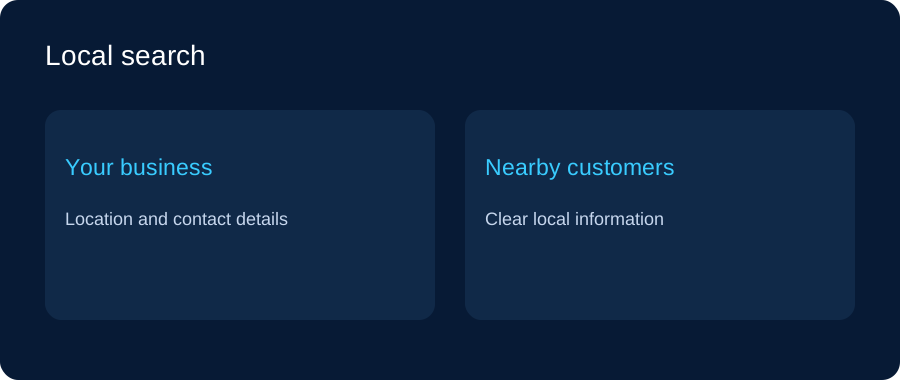
NAP = Name, Address, Phone. This information must be identical everywhere: on your website, on Google Business, on directories, on your social media. Google checks for consistency.
Customer reviews
Google reviews are a major ranking factor in local SEO. Systematically ask your satisfied customers to leave a review. Reply to all reviews, both positive and negative.
A fast, mobile-friendly website
Over 60% of local searches are done on mobile. If your website is slow or poorly adapted to smartphones, Google penalizes you. It's as simple as that.
Local SEO isn't magic. It's common sense, discipline, and a bit of technical know-how. And the results are often quick to see.
Performance
Your website takes more than 3 seconds to load? You're losing customers.
53% of mobile visitors leave a site that takes more than 3 seconds to display. Here's how to diagnose and fix performance issues.
7 min read
Core Web VitalsOptimization
Google has been clear: loading speed is a ranking factor. And beyond SEO, it's also a matter of user experience. A slow website is a website nobody visits.
How to measure?
Two free tools are enough:
Google PageSpeed Insights — analyzes your site and gives a score out of 100
Lighthouse (built into Chrome) — full audit: performance, accessibility, SEO, best practices
The most common causes
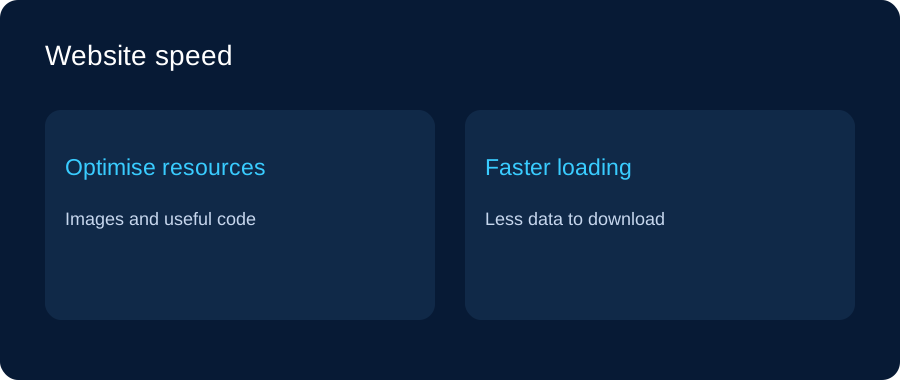
Unoptimized images — a 5 MB photo where 200 KB would suffice
Too much JavaScript — plugins, trackers, widgets piling up
Slow hosting — an overloaded shared server
No caching — the browser re-downloads everything on each visit
Heavy web fonts — loading 8 variants of a Google Font
Quick fixes
Convert images to WebP or AVIF
Enable GZIP compression on the server
Configure cache headers
Remove unnecessary JavaScript
Defer loading of non-critical resources
A performance audit is often the first step towards a website that converts better. And that's exactly what we offer in our audit service.
Technical
Web technologies in 2026: what has changed
CSS Container Queries, View Transitions API, the AVIF format... The web evolves fast. Here are the innovations that truly make a difference.
8 min read
CSSJavaScript
The web in 2026 is an incredible playground for developers. Browsers finally support features we've been waiting for years. Here are the ones that truly matter.
CSS Container Queries
Gone are the days when you could only adapt a component based on the window size. With Container Queries, a component can adapt to the size of its container. It's a fundamental change for responsive design.
View Transitions API
Page transitions without complex JavaScript or frameworks. The browser natively handles transition animations. The result: websites that behave like apps, with a fraction of the complexity.
The AVIF format
AVIF offers 50% better compression than WebP, with equivalent quality. All modern browsers support it. It's the new standard for web images.
Native CSS Nesting
No more needing Sass just to nest selectors. Native CSS now supports nesting. A welcome simplification for projects that want to stay lightweight.
Popover API
Tooltips, modals, and context menus can now be handled natively by the browser, with a simple and accessible-by-default API. Less JavaScript, more reliability.
These developments reinforce our belief: you can build remarkable websites with native web technologies, without heavy frameworks or complex dependencies.
SEO
Schema.org: the secret to standing out on Google
Structured data helps Google better understand your website and display rich results. It's easy to implement and it changes everything.
5 min read
Schema.orgRich Snippets
Have you ever seen those Google results with stars, opening hours, prices, or FAQs right on the results page? Those are rich results, and they're generated thanks to Schema.org structured data.
How does it work?
You add a small JSON-LD code block to the HTML page. This code describes the page content in a format that Google understands: "this is a local business", "here are its hours", "here are its reviews".
The most useful types
LocalBusiness — for shops and craftspeople (address, hours, phone)
Article — for blog posts (author, date, description)
FAQ — for frequently asked questions pages
Product — for product pages (price, availability, reviews)
Event — for events (date, venue, price)
The impact on SEO
Structured data isn't a direct ranking factor. But it significantly increases click-through rates: a rich result catches the eye and inspires trust. More clicks = more traffic = better rankings over time.
On this very website, we use Schema.org LocalBusiness. It's a practice we systematically apply to all the websites we build.